acceptance and radical self-love

When Asked How I Was Inspired by my Mother

8:37 PM


My mother raised me, well, all four of her girls, to make our beds, to be prompt for dinner, and to do our homework before we watched TV. She ran a tight ship.

While this probably doesn’t sound very remarkable, please consider the setting. My precious (late) mother was the wife of entertainer Pat Boone, and upon hearing or speaking that singular aspect of her resume, she has always been swift to add that she never expected, or even wanted, to be the wife of an entertainer. She had married a 19-year-old Tennessean who aspired to be an English teacher (ironically, the job that I have come to embrace). My mother worked passionately to nurture an environment for her daughters that would at least feel somewhat normal, and that’s what makes the household routine that she envisioned and acted out unique.

Bedtimes, bath times, trips to church and holiday traditions were by design predictable and comforting, and although I will never understand Mama’s need to clean the plastic placemat 10 minutes before I have finished my Teriyaki Chicken, her signature sense of order and discipline are present and appreciated in my home in Colorado, and in the Middle School classroom where these traits were not only valuable; they were essential.

The gift that Mama had for imagining any and all crises before they happened so that she would have every opportunity to prepare for any scenario is not really the quality that comes to my mind when I am asked about how I have been inspired in her presence. When I was asked how Shirley Boone has been an inspiration to me, the memory that invaded my mind took me back to my years as a freshman in college.

After decades of being parented with precision, having decisions made, for the most part, on my behalf, I was floundering at school, torn between the disciplines of my childhood, and the vast array of options available to an inexperienced 19-year-old girl, suddenly on her own in Malibu. I focused as well as I could on my studies, but the anxiety that came with school, along with the newly acquired pressure to self-realize, was formidable; I felt I was deconstructing before I had an idea of who I was, or wanted to be…feeling invisible, afraid and confused, my college experience made me question my previous, family-centered identity, offering no real alternative, at least, not fast enough for me to acclimate.

In this context, and for some reason I don’t exactly remember, I took up smoking.

Devastated that my college days were more frightening and uncomfortable than relaxed and festive, as I had anticipated, I remember calling Mama in tears, and she swiftly met me for lunch somewhere in Santa Monica. Waiting for lunch to arrive, I vividly remember thinking this might be hard on her, but I wanted to be authentic and have a real conversation, so I pulled out my Marlboro Lights, and in one swoop, I put one authoritatively in my mouth, and lit a match. My traditional Christian mother sighed, asked for God’s grace under her breath, smiled at me, and the conversation continued.

What makes this memory special enough to be the image of her presence in my life?

I guess it’s the fact that she didn’t lecture me…she didn’t remind me about how God might feel about it …she didn‘t even appeal to me as a mom who was, and is, very concerned about my well-being. (I was already very focused on my own stinging awareness of these salient points). In an intuitive moment, she recognized that our relationship had evolved, and she evolved with it. She loved me the way that I came to her: cocky and self-justified, vulnerable and yet, terribly, painfully afraid.

She sensed that I needed her to listen and care, without a lecture, and she morphed into a different kind of mother right before my eyes. She melted my resistance to being open with her, cementing a foundation for many, many similar talks that would follow over the years.

Decades later, when my 16-year-old son Michael left home suddenly and unannounced, cocky and self-justified, yet vulnerable and terribly afraid, and I had already exhausted myself, unsuccessfully attempting to dictate what he should do, and who he should be, I knew that it was my turn to adapt…to morph…and mercifully, our conversation continued.

When I picture my mother’s response upon reading this anecdote, I imagine the inner Shirley saying, “of ALL the moments we’ve shared in our lives together, couldn’t you have remembered anything else?”

Nevertheless, I am assured that my mother has come to know me not only as her daughter, but as a person.

She’ll understand.

                                               Copyright © 2021 Laury Boone Browning


acceptance and radical self-love

The Finish Line Is Now

2:20 PM

Photo by Guillaume Bolduc on Unsplash
So, I've been noticing that when I'm on my walk in the morning and I'm headed towards home, the closer I get to my house, the more I pick up my pace. Like a horse, trotting toward the barn.

Why this instinct to cross an imaginary finish line?

I was thinking about this last weekend to when Pastor Peggy decided to take us all out to the backyard labyrinth for a little collective walking meditation. I've never been on a labyrinth, so it was mesmerizing. It was also unique in that everyone present at the church service was also walking the labyrinth at the same time providing a range of experiences
.
When this quiet and reflective exercise was over, and we had gone back inside, Peggy asked us what we observed or learned while we were walking. Naturally, everyone had a unique experience.

Of course, I was swimming in a deep pool of thoughts upon which I might to ruminate, but eventually, I settled on sharing these two things.

First, during my walk, I was acutely aware of the interplay between solitude and community.

I wanted to enter my own experience, to focus on breath and connect internally. But surrounded by all these others, I also wanted to interact, embrace, guide and encourage. After feeling conflicted at first, I gradually accepted the oscillation that seemed to happen naturally between the two. Sort of like it tends to happen in life, perhaps less consciously.

The other awareness centered around what I would call an occasional glance toward the finish fine, which in this case, is the center of the labyrinth.

Of course, this is ludicrous with a labyrinth as the whole point is to be on the path, not to "finish," or to get somewhere first. I learned while I was still in my teens that my name is rooted to the Laurel wreath, the garland put on the Victor's Crown after winning an important race. Laury, then, by all accounts, is a reflection of the word victorious.

Laury…the Finisher.

The running of my personal race has always been peppered with a painful sense of loss over terrible mistakes I've made in the past, decisions I made without the tools to choose wisely.
Struggling for a lifetime around codependency, attachments, fear and lack of trust in myself led me to a giant pile of regrets, regrets that tend to make me feel like I have to make up for lost time or redeem the losses somehow. Surely all of this pain isn't for nothing?

Of course, it isn't.

Like an obstacle course, the challenges we face and the decisions we make lead to a destination of our creation.

Although I wish I could have done my obstacle course without hurting anyone else, and without causing myself pain and suffering, when I look at where I've landed at the end of it all, I know I need to make peace with it, choosing gratitude in the present as a guide.

Continuing to suffer for past lapses in judgement will only perpetuate more suffering; it also drives our focus backwards into regret and guilt, or forward into worry or fixing.

I don't know whether I'm "winning" my race, exactly. I do have this feeling though, a feeling that's rich with compassion and joy, that the finish line isn't out there somewhere. It's here, under my feet, right where I stand.

This is where my experiences are coming into focus, and where decisions are being made in the moment, the ones that create my story.

And if the finish line is now, then I guess I've made it. Well done.


                                            Copyright © 2018 Laury Boone Browning
                                                               

acceptance and radical self-love

Mothering

8:17 PM


If you bungle raising your children, I don’t think whatever else you do well matters very much. -Jacqueline Kennedy Onassis

I mean, is it me, or is this a really harsh overview, considering that mothers are all pretty much…imperfect? OK, maybe I’m being defensive, but…nothing else I do matters anymore? Not “very much?” Can we at least define the word, “bungle?”

On Mother’s Day, we can’t help but reflect on our own perceptions of our histories, our experiences with our own mothers, and our experience of being mothers. For some of us, this reflection represents a labyrinth of emotions, either difficult or satisfying. Mostly both.

As for me and my mom? 

My mama, Shirley Lee Foley Boone, passed on January 11, 2019. But in reflection, it’s clear to me that my issues with her had for the most part resolved themselves, leaving behind a forgiving, nurturing, tender mother-daughter relationship we enjoyed in her later years.

There are a few reasons for this recovery. For one thing, even though this epiphany has taken a few decades, it’s become clear to me as an adult that my mom loved me and did her very best to shelter me, giving me the life she had only dreamed of as a child. Equally impactfully, my own inability to protect my children from spending their formative years in a chaotic, dysfunctional environment has created space for the compassion I’ve needed to be able to understand how hard it is to parent before accumulating the tools we need in order to parent ourselves.

Parenting, or even just adulting, is challenging.

Adapting and Bouncing Back

I’ve spent a little bit of time in therapy recovering from, well, a lot. Recently, my no-nonsense therapist recommended the book, Bouncing Back: Rewiring Your Brain for Maximum Resilience and Well-Being, by Linda Graham, MFT; I’ve been devouring it for the last few days.
Amazon offers the following blurb for anyone interested in purchasing the book:

"Resilience is the ability to face and handle life’s challenges, whether everyday disappointments or extraordinary disasters. While resilience is innate in the brain, over time we learn unhelpful patterns, which then become fixed in our neural circuitry. But science is now revealing that what previously seemed hardwired can be rewired, and Bouncing Back shows us how."

The book offers strategies for forward motion after facing traumatic events, laying out a breadcrumb trail directly to our wiser selves…perhaps, a shortcut that can take us slightly further than our therapists are able.

Therapist and author Graham establishes in her first chapter that “interactions with others — such as experiencing empathetic, responsive, parenting — instill a sense of safety and trust, a sense of importance and being loved, and a sense of mastery that become your brain’s first templates of resilience and serve as lifelong buffers from stress and trauma.” (27)

But what if these interactions are unstable?

Resilience Gone Awry

The author moves on to describe the ways that our pathways for learning resilience can go awry, offering the following early childhood scenarios.

Insecure-Avoidant attachment can lead to coping that is stable but not always flexible.

Insecure-Anxious attachment leads to coping that is flexible but not always stable. Finally, 

Disorganized attachment leads to coping that is neither stable nor flexible.

I’ll go ahead and admit I may be the uneasy product of Insecure-Anxious attachment…flexible, yes, but definitely not always stable.

This form of an attachment malfunction happens when a parent is “consistently inconsistent, sometimes attentive and loving, and at other times harsh or punitive, sometimes over-involved and at other times in their own world…”

The author summarizes, “adults who never felt secure with a parent or sure of themselves are painfully subject to abandonment fears and can be hyper-vigilant about loss of connection. The capacity for resilience can be too easily derailed to become passivity, and anxious preoccupation of what others think of them, or a sense of victimhood.”(32)

So, now for the good news.

The study of the brain’s neuroplasticity has made it clear that “we can learn to bounce back better by consciously rewiring our brains' learned patterns of coping.” (xxvii) Current theories on neuroplasticity tell us we can use new experiences and strategies to rewire old patterns.
Graham explains that disciplined practices of mindfulness and empathy, or mindful empathy, “is the single most important tool for strengthening the functioning of the prefrontal cortex.” (51)

The Story

Before I get around (finally) to the purpose of this post, this may be a good time to mention that while my mother may have been the conduit through which an insecure-anxious attachment disorder might have found a home in me, I’m convinced that, even though her childhood was more tumultuous and challenging than my own, she did a much better job than I building stability and consistency while raising her children.
Nevertheless, I always knew something was missing in the bond between my mother and I while I was little. Truthfully, I was pretty convinced she didn’t like me, but my limited decoding skills may have been lacking the tools to interpret some subtle cues.

In my thirties, while raising my very young children in a home that was extremely dysfunctional, I had begun to wrestle with my own inadequacies. Once, when I reached out to my mother to look for support, to sort out the disorder and dysfunction that was threatening my family, she offered some insight.

Sitting in a dingy airport motel all alone, lamenting the terrible disturbances that were beginning to erupt on a regular basis at my home in Texas, I reached out to my mother for comfort, and the scene is still touching to remember. In an attempt to offer me some relief, absolution of sorts for my own inadequacies, my mother generously told the truth about her emotional state during the months that she carried me, even continuing into my early childhood. She told me about my father’s business, and about the amount of professional hours he spent with beautiful young ingenues, women who enjoyed pre-childbirth figures and carefree lives. She was insecure and filled with anxiety.

After giving birth to three children in under three years, she had decided she would try to be her best self, whipping her body into pre-pregnancy shape. My very young parents were struggling to build their lasting relationship in an ocean of challenges, and about the time my mother was starting to feel beautiful again, she found out she was pregnant with me, her fourth.

In that Motel 6, crying on the bed, I listened to my sweet mother tearfully tell me how devastated she was to face another pregnancy. Although she had never considered abortion, she shockingly admitted that, at times, she had she had allowed herself the weak comfort of hoping that the pregnancy would end early, naturally.

Decades later, in this moment of intimacy, she tentatively and gently wondered out loud, had the nature of my point of entry, and the negative emotional climate, impacted the way I felt about myself, and the way I approached challenges in my own relationships?

She continued to share with me her own lack of resilience in facing the demands I placed on her as a (fourth!) baby and toddler, and the way my energy and temperament exhausted her more than the other girls ever had. She was exasperated, frustrated, and agitated.


It was a beautiful, honest conversation in which my mother expressed her fallibility in those early years, but emphasized her deep, deep love and affection for me as I grew, as well as her affinity for me as an adult daughter. She ask my forgiveness, and offered up this piece to the puzzle that I now reflect on as I read about the way resilience and “bouncing back” is tied to attachment issues.

My mother gave all she had, investing in her household and her children in every way she could at the time, growing over the years to deepen our relationship and to build honesty and intimacy.

Nevertheless, subtle messaging in the early years is programming, binary systematic programming that sets certain ways of operating in motion. Flexible, not stable.

If my mother could have, in her wildest dreams, gone back and done things differently, wouldn’t she have? I know I would love a do over with my kids' early years, but I’m afraid that isn’t on the menu for today.

Uncoiling the Twisted Knot

So, what to do?

Let’s get back to this idea of mindful empathy.

If disturbances in early childhood create coping strategies that may eventually lead to emotional fatigue and lack of resilience, then it stands to reason that healthy emotional relationships in the present have the potential to grease the twisted knot of unsustainable thinking and practices. It’s a process, but I’m coming to understand that the way we do relationships right now can rewrite the programming, or at least, offer specific adaptations, creating a different overall experience going forward.

My day job has been the surprising catalyst for this forward motion in my own life. Most days, I am a full-time caregiver for one of my grandchildren, a gift that is impossible to quantify. One of the benefits is hanging out with moms.

The children are small, so we aren’t caught up yet in the ritual of school and sports activities that come with parenting. Right now, it’s about parks, story times at the library, museums and craft activities, many of which are shared as we frequent the same places.

We seek companionship for our children, and secretly for ourselves, as we attempt to build community during the potentially isolated years of early child care. Why go to the Discovery Museum alone when we can do it with friends?

“The roots of resilience are to be found in the felt sense of existing in the heart and mind of an empathetic, attuned, self-possessed other.” 
Diana Fosha

I had no idea when I embarked on this journey with my grandson that my connection with these women and their children would offer a nurturing environment in which I can observe empathy in action, rediscovering “…the urgent need of the human mind to re-envision ourselves in the world, and the boundless depths of the human heart and soul to care.”

I’m so grateful for mindfulness practices, morning meditation and breathing throughout the day; my fledgling work in this arena has offered me just-enough-space in my trauma-injected brain to observe, to really give attention to, the gifts these women bring to the community table. I find myself noticing all the time how these women instinctively use the elements of empathy, not only in the way they relate to their children, but to themselves and each other.

I wanted to take a minute to reflect on, and honor, the way they teach me.

Mothering

According to Graham, “five elements of empathy are essential for maturing the prefrontal cortex in the first place, and we’re continuing to strengthen it throughout our lives.”

Resonance: picking up the “vibe” of other people

Attunement: feeling your way into another person’s experience and “feeling felt” by them

Empathy: making sense of your experience or another’s, conveying a shared understanding of the meaning of the experience, and sensing that any experience is completely understood and accepted

Compassion: literally “feeling with,” keeping the heart open and caring in the face of struggling or suffering

Acceptance: coming to terms with what is or has been so that you can cope going forward (p. 69)

While my days are filled with play, laughter, and the sharing of caregiving tools that are natural in this environment, these days are also filled with aha moments, moments of enlightenment, in which I find myself pausing to take in, and remember, some beautiful elements of empathy, in action.

Mia, a single mom, finds comfort praying for others in an organized prayer room that focus on healing. She seeks out, actively, ways that she can support people around her in tangible ways, offering caregiving, food, or even babysitting. And she paints. When my daughter was suffering with an illness that brought about an emergency visit to the hospital, Mia took the time to tune in to my daughter’s experience, drawing and painting a prayer for her by way of a specific image for my daughter to re-image herself filled with grace and courage.

Mia was modeling resonance, the gift of tuning in to build connection and empathy.

While resonance is more vibrational, acting outside our normal patterns of conscious processing, attunement reads emotions of others “mostly through nonverbal signs of facial expressions, body language, and tone of voice.” (p. 72)

Teaching attunement in practice, I’ve watched my beautiful friend Kelly again and again as she trains her children in the art of empathy.
“Katie, look at Sam’s face. What do you think he’s feeling?  What do you think could make him feel better?”

Children over the years have been forced to build their own paradigms, constructing what they know from what we do. Kelly regularly and consistently goes the extra mile, not just practicing attunement on her own, but teaching this awareness to the little ones around her so that they are not left to wonder how to build empathy in their interactions. Life around Kelly is like a workshop; we learn by demonstration in practice.

Attunement is one part of the larger umbrella of Empathy, and of course, empathy “…works to move beyond noticing and naming emotional experience to generating a cognitive understanding of that experience: to be aware of why somebody… might be feeling the way they do.” (P. 74)

Andie is a beautiful listener, an important skill in the art of empathy. She expresses her listening through art, painting portraits for friends and clients with a well-articulated sense of what lives behind their eyes, attempting to convey the spirit and soul as much as features and tone.
She paints late at night because she has two small daughters; I’ve tried to imagine how she maintains that energy, focus and sensitivity after pouring herself into her children and home, but it seems to be an expression of love and spiritual connection. Of course, the work she does is restorative.

I’ve watched as she consistently and actively empathizes with her daughter, through tantrums and miniature heartaches, allowing space for feelings that other parents would simply attempt to extinguish.
Sitting with me at an outdoor garden while the children run and play, she has teared up listening to me share my challenges, seeking to understand, a gift I will always be grateful for: empathy in action.

While empathy seeks to understand our responses and the responses of others, compassion holds space for, according to Graham, “feeling with” the other.

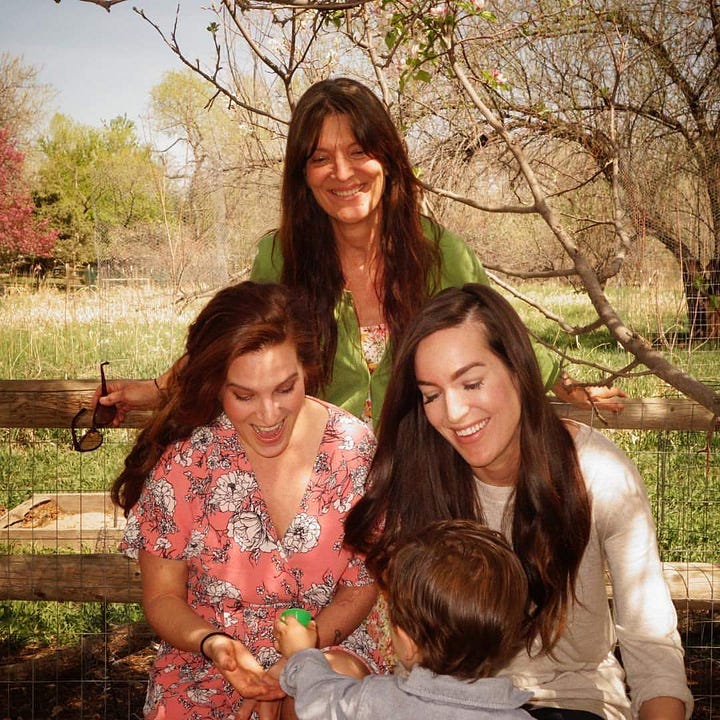
Sara, my first born twin, wears a tattoo on her arm of a line from a Shawn Colvin song that says, “if you need someone to walk with in the dark, I’m your man.” Not an advertisement to the wide wide world, the quote is meant as a shout out to me, her mother, both as an offering of support and an acknowledgement of the kind of compassion that I’ve been able to recognize and appreciate in her.

Sara was raised in an unsteady environment in her childhood home life, and although she no longer identifies as a child of trauma, she has accessed compassion for herself, and others, due to her at-times horrific experiences. She has done the work of finding healing and personal grounding, of stabilizing herself in an emotional storm, making it possible for her to offer a hand to someone else who may be faltering. This work has not been easy, but over the years, Sara has acquired an expansive emotional vocabulary; she is able to “feel with” others while maintaining her own groundedness, a delicate balance for anyone.
When I picture my own passing, it’s nurse practitioner Sara I see holding my hand.

Compassion makes room for acceptance, allowing us to come to terms with our experiences and learn from them. To grieve our losses, to create new pathways, and to hone new responses to future challenges.

Rachael, my youngest twin daughter who arrived twenty minutes behind Sara, has been doing the hard work of healing after harsh decades of carrying terrible burdens and scars from a painful childhood. The inequities of life dealt her many hard blows due to the carelessness, and even cruelty, of individuals who should have been tender caretakers.

Anyone in her position, carrying the weight of an unfair history, could easily rationalize living knee-deep in resentment, anger and entitlement. She has chosen the path of acceptance and healing, with all of its heavy lifting and infinite increments. She’s decided to break the cycle of pain that was her inheritance, and look ahead to healing her life, dreaming empathetically of providing opportunities for others to benefit from her process. And she’s chosen to focus her life on paving a path of loving protection and nurturing shelter for her young son. It’s hard to measure the cost of these choices, but she moves ahead, focused on healing and redemption, “coming to terms with what is or has been so that (she) can cope going forward.”

Perhaps, the presence of these women, and the gifts they bring, has gently helped position me in the present to be able, easily able, to have compassion for my mother, especially juxtaposed against the painful awareness of my own failures.

Coming full circle, I might be able to come to terms with my failure as a mother, my impotence in protecting my children from traumatic experiences. I trust that someday, possibly in the near future, I will be able to deeply and compassionately forgive myself, to acknowledge without blame or shame that I did not have the tools at the time to solve the Rubik’s Cube of my family’s dysfunctional dynamics.

We lay our judgment at the door, once and for all removing ourselves from blame and shame when finally we realize they no longer serve.
There are losses to be counted, but be there’s a reason that the art of mothering (and fathering) lies at the heart of our spiritual traditions.
Some talk of God as if he were a Father, and certainly, many acknowledge the mother heart of God as evidenced in nature...and our "Mother Earth."

Having become a part of my community of moms, I’m starting to believe that mothering is not only defined biologically. It’s spiritual.

In the same way the Earth exists within a constant state of regeneration, so are we as mothers. My mother evolved, not just as an individual engaging in growth and renewal, but through the eyes of her daughter as my perspective enlarges.

I have changed through the eyes of my daughters as their perspective shifts.

But the biggest surprise has been this awareness that mothering continues through my community of nurturing women, my family, and most surprisingly, myself.

I play a part in this divine practice of mothering myself. I have bungled being a mother. I have bungled being a daughter. I will probably continue to bungle some really important relationships.

But I respectfully disagree with Jackie Onassis. It isn’t over.
And everything I do from here matters.

Very much.

                                            Copyright © 2018 Laury Boone Browning


Popular Posts

Like us on Facebook

Followers